Why Water Is Dripping From Your Ceiling in August
In peak cooling season, a ceiling leak is far more likely to come from your attic air handler than from a roof problem.
August 25, 2026 · 3 min read
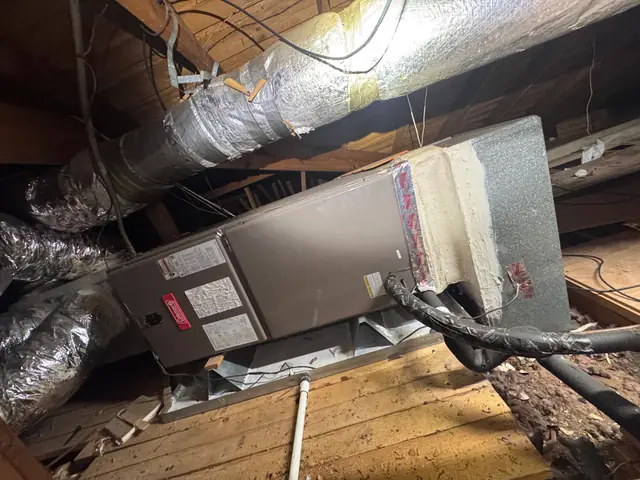
It hasn't rained in weeks, but there's a wet spot spreading on the ceiling below the attic, or worse, actual dripping. Your first instinct is probably the roof. In the middle of a Texas summer, with the AC running most of the day, the far more likely source is the air handler sitting in your attic, and specifically its condensate drain.
Where the water comes from in the first place
Your air handler doesn't just cool air, it dehumidifies it, and all that moisture has to go somewhere. As humid air passes over the cold evaporator coil, water condenses out of it, the same way a cold glass sweats on a humid day. That water drips into a drain pan underneath the coil and is supposed to flow out through a condensate line, usually PVC pipe, to a drain outside or into a household drain. On a hot, humid day the coil can pull several gallons of water out of the air. That's normal. The problem starts when that water can't get out the way it's supposed to.
What actually clogs the line
The condensate line is a narrow pipe running warm, damp, and dark for most of its length, which is exactly the environment algae and mold like. Over months, that buildup narrows the pipe until water can't drain fast enough, or it blocks it completely. Dust and debris from the attic can add to the clog. Once the line backs up, water has nowhere to go but back into the drain pan, and once the pan overflows, it goes wherever gravity takes it, usually straight down through your ceiling.
What to check before you call anyone
- Find where the condensate line exits outside your house, usually a white PVC pipe near the foundation, and see if water is dripping from it. No drip at all during a running AC cycle can be a sign of a clog upstream.
- If you can safely access the attic, look at the drain pan under the air handler for standing water or visible overflow.
- Check whether your system has a secondary drain pan with its own overflow line running to a visible spot, often above a window or exterior door. Water at that spot means the primary pan is already overflowing.
- If your system has a float switch (a safety device that should shut the AC off automatically when the pan overflows) and the unit isn't shutting off on its own, that switch may not be doing its job.
- Turn the system off at the thermostat if you see active dripping. That stops the coil from producing more condensate while you sort out the clog.
Why a float switch matters
A properly installed float switch sits in the drain pan or the line itself and is designed to cut power to the system the moment water rises too high, before it overflows the pan. If your system doesn't have one, or it's stuck and not functioning, the pan can overflow every single time the line clogs with no automatic warning, which is exactly how a slow drain turns into a ceiling stain. If you've had this happen before, a float switch is worth asking about specifically.
A clogged condensate line is one of the more common calls we get in August, and it's usually a straightforward fix once someone's up there with the right tools. If you've got active dripping or a stain that's spreading, turn the system off and give us a call at (281) 705-6401.
Spring Woodlands Air Technicians, (281) 705-6401
Call (281) 705-6401More articles
Why Your AC Runs All Day and the House Still Won't Cool
If the thermostat says the unit is running nonstop and every room still feels warm, the problem usually isn't the thermostat.
The Capacitor: The Cheap Part That Takes Out Expensive Ones
One small cylindrical part is responsible for more dead-of-summer AC calls than anything else we see.