The Capacitor: The Cheap Part That Takes Out Expensive Ones
One small cylindrical part is responsible for more dead-of-summer AC calls than anything else we see.
August 25, 2026 · 3 min read
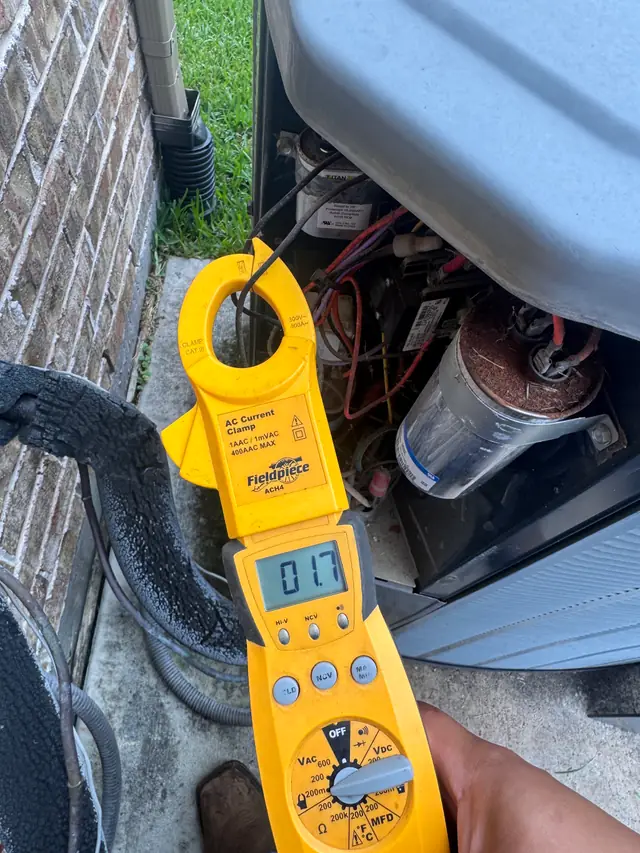
You flip the thermostat down, walk outside, and the condenser is just sitting there. Maybe you hear a faint hum or a click, but the fan isn't spinning and the compressor isn't running. Inside your home the air handler might even be blowing, just blowing warm air, because the outdoor half of the system never started. Nine times out of ten in the middle of a Texas summer, that's a capacitor.
What a capacitor actually does
The run capacitor is a small cylindrical part inside the outdoor unit that stores an electrical charge and delivers it in a burst to help the compressor motor and the condenser fan motor start and keep running smoothly. Think of it as a shove that helps a heavy motor get moving, then keeps it running steady once it's up to speed. Without a working capacitor, the motor either won't start at all, or it starts weak and strains every time it tries.
Why it fails, and why summer is when you find out
Capacitors don't usually fail all at once. They drift. Heat is the main enemy, both the ambient heat of a Texas summer and the heat the unit generates just by running long hours day after day. Over time the capacitor loses its ability to hold a charge, a little at a time, until one day it can't deliver enough of a push to start the motor. That's why a unit that ran fine in June can suddenly refuse to start in late July or August. It's not a coincidence, it's the exact conditions that finish off a capacitor that was already weakening.
The symptoms worth knowing before it fails completely
- The outdoor fan doesn't spin, but you hear a hum or a faint clicking sound. That's often the compressor trying and failing to start.
- The unit starts, but only after you help it, or only intermittently.
- The fan spins slowly or hesitates before catching speed.
- The unit shuts off on its own after running only a few minutes.
- You hear a rattling or humming sound from the outdoor unit that wasn't there before.
Why this small part matters more than its size suggests
A struggling capacitor doesn't just risk not starting. When a motor is forced to strain against a weak or failing capacitor, it pulls more current than it's designed for, and that heat and strain is exactly what burns out compressor windings and fan motors, the two most expensive parts in the entire outdoor unit. A capacitor is a small, inexpensive part. A compressor is not. Letting a struggling capacitor limp along is how a small problem becomes a five-figure one.
One thing you can check, carefully
If your outdoor unit is humming but not spinning, do not stick anything into the fan grille to try to spin it manually while the system is powered. That's a real shock and injury risk. What's safe to check is simple: look at the top of the capacitor itself if the panel is easy to remove with power off at the breaker. A healthy capacitor has a flat top. If the top is visibly bulged, domed, or has any residue leaking from it, that's a clear sign it's failed or is about to. If you see that, or you're not comfortable opening the panel at all, that's exactly the kind of call worth making before the compressor takes the hit instead of the capacitor.
If your AC is humming, clicking, or shutting off on its own, don't run it repeatedly trying to force a start; that's how a capacitor problem becomes a compressor problem. Call us at (281) 705-6401 and we'll check it.
Spring Woodlands Air Technicians, (281) 705-6401
Call (281) 705-6401More articles
Why Your AC Runs All Day and the House Still Won't Cool
If the thermostat says the unit is running nonstop and every room still feels warm, the problem usually isn't the thermostat.
Repair or Replace: How to Decide Without Being Sold To
The right answer depends on a small number of concrete facts about your specific system, not a sales pitch.