Repair or Replace: How to Decide Without Being Sold To
The right answer depends on a small number of concrete facts about your specific system, not a sales pitch.
August 25, 2026 · 3 min read
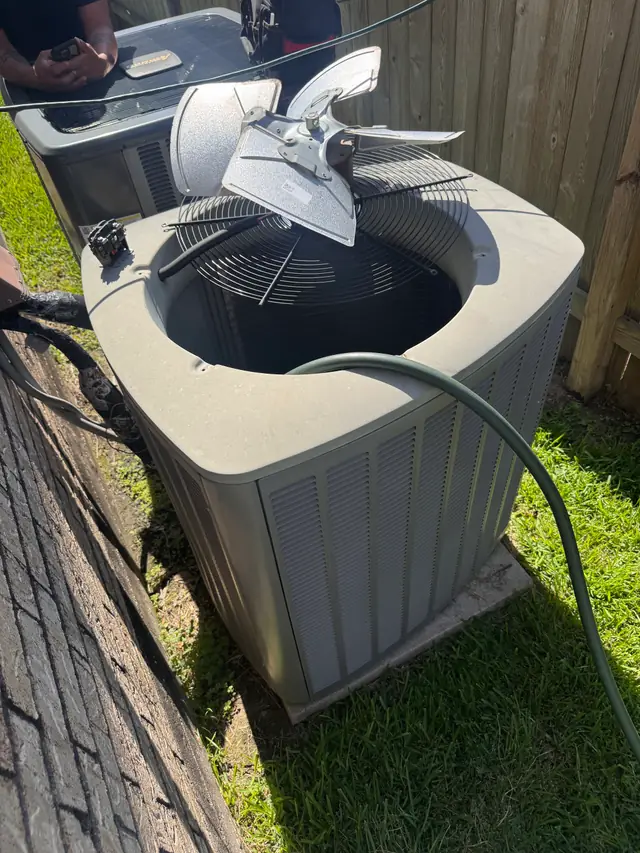
Your system just broke down for the second time this year, and now you're standing in the driveway trying to decide whether to fix it again or start over. It's a real decision, and it deserves more than a gut feeling. A few concrete facts about your specific unit will tell you more than any general rule of thumb.
Age is a starting point, not the answer
Most residential AC systems are built to last somewhere in the range of 12 to 18 years with regular maintenance, though plenty run longer and some run shorter depending on how hard they've worked and how well they've been looked after. A five-year-old system with one failed part is almost always worth repairing. A 16-year-old system is a different conversation, not because age alone kills a unit, but because age tends to arrive with a second and third factor that matter more.
The refrigerant question
One of the biggest practical factors is what refrigerant your system uses. Older systems were designed around R-22, which has been phased out of production. If your system uses R-22 and develops a refrigerant leak, you're not just paying to fix the leak, you're paying a premium for a refrigerant that's increasingly scarce and expensive, on a system that's already old enough to be near the end of its expected life. That combination, an aging system plus an obsolete refrigerant plus a leak, is usually where replacement starts to make more sense than repair.
Watch the pattern, not just the bill
A single repair on an otherwise healthy system doesn't mean much. What matters is the pattern. If you've had a technician out multiple times in the last year or two for different issues, unrelated parts failing one after another, that's the system telling you it's wearing out broadly, not just unlucky about one component. A capacitor this spring, a contactor over the summer, and now a coil leak in August isn't three separate bad breaks. It's a system reaching the end of its service life on multiple fronts at once.
Questions worth asking before you decide
- How old is the system, and does it use R-22 or a current refrigerant?
- Is this the first real repair, or the third in the past year or two?
- Is the failing part central (compressor, coil) or peripheral (capacitor, contactor, fan motor)?
- Has the system been keeping up with the house, or has it been struggling even before this breakdown?
- Would a replacement also let you correct a sizing problem the original system had?
What actually justifies replacement
In practice, replacement tends to make sense when two or more of these line up: the system is old, it uses an obsolete refrigerant, the failing component is a major one like a compressor or coil rather than an inexpensive part, and it's had a genuine pattern of unrelated breakdowns rather than a single isolated failure. A repair almost always makes sense when it's a young system, a current refrigerant, an inexpensive component, and a first-time issue.
If you're on the fence, ask whoever's out at your house to walk you through the specific facts on your system rather than a general answer, and get a second opinion if it still doesn't sit right. We're happy to give you a straight read on your specific unit. Call us at (281) 705-6401.
Spring Woodlands Air Technicians, (281) 705-6401
Call (281) 705-6401More articles
Why Your AC Runs All Day and the House Still Won't Cool
If the thermostat says the unit is running nonstop and every room still feels warm, the problem usually isn't the thermostat.
The Capacitor: The Cheap Part That Takes Out Expensive Ones
One small cylindrical part is responsible for more dead-of-summer AC calls than anything else we see.